Leading a startup is hard conversations.
With your co-founder. With investors. With your board and your first hires. These conversations decide more than your decks do.
- ✓ 60-minute live coaching session
- ✓ The angle and first sentence for your next hard conversation
- ✓ Desensitization visualization custom built for you, recorded
- ✓ 20-minute follow-up debrief included

"Working with Dave was one of the best coaching experiences I've ever had."
Aaron Davis, CTO & Senior Software Engineer · ★★★★★ LinkedIn ↗People buy your argument after they buy you.
Your co-founder and your investors are asking the same question. Can I trust how this person handles pressure? No spreadsheet answers that. That's a leadership and performance problem, and more data won't fix it.
Your co-founder isn't convinced
You brought the research. You brought it again. Each time, they found a reason to leave it alone. The reason they gave usually isn't the real one.
Investors aren't convinced
They liked the idea. The feedback wasn't about the product. It was about whether you're ready for how hard this gets.
Not being heard
You've raised the same issue a few times. The facts don't move anyone until someone else says them.
Not reading as grounded
You're optimistic, and it's part of why you started this. In the room, it can read as not taking the risk seriously.
Great at showing up
You're at your best in the room. The prep before and the follow-up after are where the relationship gets built, and where it slips.
All three come down to one skill: holding a hard conversation well.
You brought the research.
They still didn't hear you.
When the data isn't working, there's a hidden friction point. Usually it's a conversation someone doesn't want to have, or a read on you the deck can't change. The more you treat it as a psychological problem instead of a business problem, the easier it is to see where to intervene.
Makes your case solid. Your numbers hold up. Your logic is clear.
Get you heard. Can you stay clear headed when the pushback comes and everyone's watching how you take it?
You still have to handle the room.

"This works! Dave walked me through the pre-presentation jitters and I showed up calmer than I ever had before."
@sparking_positivity ↗Co-founders are like married couples. They have to make it work.
Three co-founders? Same rules. Three relationships to keep healthy instead of one.
I trained in Imago Relationship Therapy, a method built for couples. It works on co-founders for the same reason: when you're both sure you're right, the issue stops being the problem. How you two have the conversation is.
- Pull instead of push. Stop re-presenting the case. Ask for their help with the part that's hard for you, and they start thinking it through with you.
- The conversation about your conversations. A regular check-in on how you two work together, so one disagreement doesn't turn into a tug-of-war.
- A structure that makes it feel normal. Strengths, weaknesses, opportunities and threats for the partnership, once a quarter. The hard issue goes on the list instead of becoming the whole meeting.
The same skill runs the rest of the company. When you start hiring, the boss can always win by being the boss. A lot gets lost when that's the only way you know how to win.
Find the friction. Walk in ready.
60 minutes by Zoom. We uncover what's really stalling the conversation, pinpoint your angle, and get you ready to have it.
Uncover
First 30 minutesThe hidden friction point. We look at the last time you brought it up and find the moment it stalled, and what the other person was really reacting to.
Pinpoint
Next 10 minutesYour angle and your next conversation. We write the first sentence together, and you leave with a framework you can reuse the next time this happens.
Prepare
Last 20 minutesYou still won't want to have it. Your body treats the conversation like a threat, so we train your body, not just your script.
Light movement until your heart rate is up. Then a custom desensitization visualization of that exact moment. You keep the recording.
The cycle that was running me.
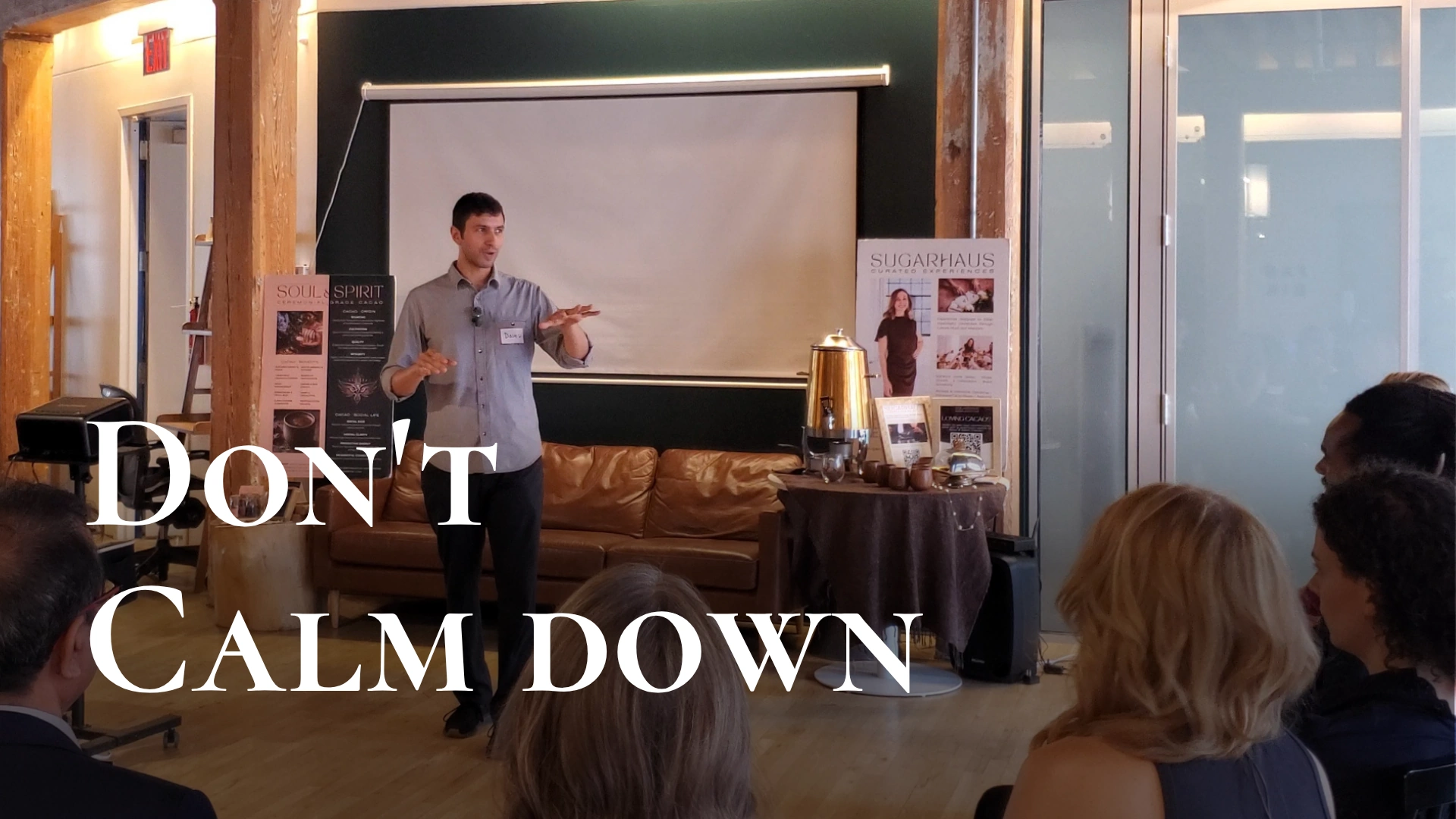
I was 25, standing in front of 50 parents, presenting on topics I knew inside out: math, psychology, the brain. I had prepared. Rehearsed. I knew my material.
And I was shaking.
Why? Because the moment I felt nervous, everything got wrapped in a story: If I'm too nervous, I'm gonna blow it. So I can't be nervous. I need to stop being nervous.
So everything I did was "managing the nervousness" instead of presenting my material. I'd scan the room to see if they could tell. I'd lose my thread mid-sentence. The nervousness made me less coherent, which made me more nervous. A vicious cycle. Self-generated.
One day, walking to a presentation, I noticed the feeling in my stomach. And for the first time I recognized it. This is the same feeling I have every single time. Before both the wins and the losses.
Years of mindfulness practice kicked in that moment. Instead of running from it, I leaned in, listening to it. Oh. There you are. My pre-presentation feeling. I know you.
That took the energy out of it. The vicious cycle stopped. When I was in front of the audience, I stopped wondering if people could see that I was nervous. My attention was where it belonged, on what I was actually saying. And it got easier after that, every time, because I knew how to meet the feeling like a friend instead of fighting it.

There's a mechanism behind this. Movement raises BDNF* and modulates the amygdala's threat response. Mindfulness practice changes the neural pathways that link sensation to fear. What felt like a "nervous personality" problem is a trainable nervous system pattern. I studied this at Columbia University (M.S. in Neuroscience & Education), and I've spent years building a process that creates this shift faster than it took me.
*Brain-derived neurotrophic factor: brain chemical that increases learning, memory, and higher thinking. It helps brain cells form new connections.
What people say
about Dave's work.
"I've gained so much clarity, focus, and balance from Dave's sessions. If you're looking to reduce stress, I highly recommend him!"

"Dave helped me better than anyone so far. I am wicked ADHD and dozens of times I have tried to develop both AM and PM routines. Gotten farther than any previous attempt so far."

"Thanks to his support, I've become more confident in my personal value and brand."

"I came out of our session with great insight and a solid action plan tailored to my needs."

"Dave helped me gain clarity in my hang-up around charging for my services. He has you stop and breathe, so you can speak from a place of groundedness."

"Dave provided exceptional service and a profound understanding of what I was actually dealing with."

"Dave's greatest impact was on my job performance. If you procrastinate, if you have impostor syndrome, Dave is the guy for you."

"Working with Dave was phenomenal. He helped me channel my skills into a workable and realistic plan."

"Working with Dave was one of the best things I did for my career. His approach was super collaborative."

A few quick answers.
Yes. Alongside the nervous system work, I have frameworks for refining pitches, presentations, negotiation plans and scripts. I'm not a specialist in your industry, but across enough sessions I've learned to spot what's unclear or missing the point. I can also help you memorize it so you don't sound scripted.
Because you care about being a high performance leader. Learning how to approach any hard conversation prepares you to approach all of them better. Investors, boards, new hires. Our work is not just about getting you a specific win. It's about upgrading who you are as a leader.
It helps to have a real one in mind, like an investor meeting, a board meeting, or the talk with your co-founder, because that's what we're calibrating to. It doesn't need to be booked for next week. The more time to prepare and practice the skills I give you, the better.
Maybe, but that's not the goal. Even top performers get nervous when the pressure is on. They just don't let the nervousness bother them. You'll still feel something before the big moment. You'll just be able to focus on what you're doing, instead of trying to stop being nervous.
One session produces a plan, and a significant shift in your nervous system. You keep the recording to keep training on your own. Some clients find it to be a good fit and want to continue deeper leadership and performance work together.
Full refund on the session, no questions asked.
Have the conversation
you've been postponing.
One hour to find the friction, pick your angle, and get ready to walk in.
Book Your Session · $180Client stories are anonymized and details changed. Coaching is not a substitute for therapy or mental health treatment.